Archive for the 'Cooking' Category


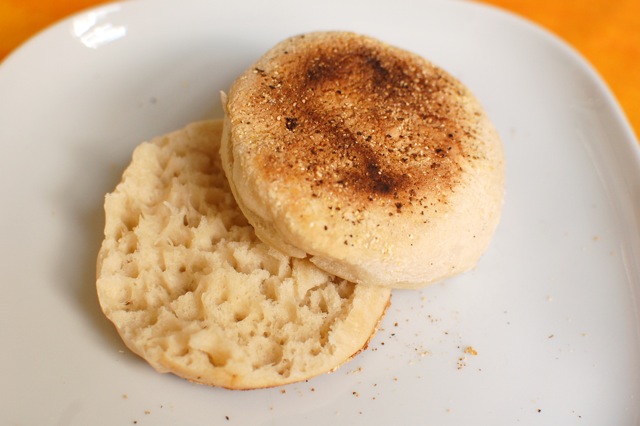
Sourdough English Muffins

Saturday, August 21st, 2010

They were pretty damn good, I must say. Toasting one right now….

Here’s a recipe, or as close as possible since I was free-styling it that morning.

SOURDOUGH SPONGE
The night before, take out of the fridge your sourdough starter (see my feature “Taming the Wild Yeast“). Transfer to a clean bowl and mix in the hootch (dark liquid on top) if you like more assertive sourdough flavors; pour off the hootch if you don’t. You’ll need about 1 cup of starter. Stir in about 2 cups of unbleached AP flour and 1 cup tepid, filtered water. Covered with a cloth and let ferment overnight.

(more…)


Wok Rings and Electric Stoves

Wednesday, July 21st, 2010


S. writes:

…how [does] one uses a wok in the contemporary kitchen (its called the science of the wok). I’m wondering, do you use a wok or a ring for your burner? I read a review on cooks illustrated that basically concluded that the wok doesn’t make sense on a standard (flat) kitchen burner. The shape seems more to me about the distribution of fats and the ability to have different zones of heat.

Any thoughts are much appreciated!

S

Hi S,

Oh goodness, I’m not sure I want to take on the folks over at Cooks Illustrated! For all his curmudgeonly geekiness, Christopher Kimball is very thorough in his obsessive testing and retesting.

But since you asked…

So many factors: Gas or electric burner? Northern Chinese wok (deeper in its curve) or southern style (wider, flatter, shallower) or even perhaps an Indian cast iron karahi? Just playing around with a few snow peas or attempting pad thai? Cooking for one or feeding a family? Just trying to be healthy or trying to impress your in-laws visiting from Hong Kong?

Purists will insist on only round bottomed woks over a very hot gas flame in a special wok burner that lets the pan sit very low and close to the flame (and NOT the same thing as a wok ring that you place over the burner — which just lowers the heat even more.)

Just for the record: regular home burners have maybe 10,000-15,000 BTU, a fancy Viking stove maybe 30,000 BTU. A restaurant’s wok burner can have 100,000 to 200,000 BTU. You will never ever get the same wok hay at home, as you will never ever create the same intensity of heat that instantly sears food on their surface while retaining moisture and tenderness inside.

But let’s say that the Kitchen God has cursed you with the sensibility of a purist and the reality of an electric coil. You can invest in a good (gasp!) flat-bottomed wok to maximize contact with the heating element. It’s the only — and I do mean ONLY — reason to use a flat-bottomed wok. However, there is NO reason for a non-stick wok.

For my day to day cooking, I use a northern-style pow wok made of carbon steel that has nearly 20 years of good seasoning. It’s jet black and virtually nonstick. More importantly, I do not use a ring but rather set the wok right down on my gas burner to obtain as high heat on the metal as possible. Cantonese-style woks, however, tend to be more difficult to use and require even greater levels of heat. If you must use one of those extra wok rings, then flip it upside down so that its wider taper is at the top, thus allowing the wok to sit lower.

Just for the record: lots of people have the right equipment but overload their wok (steaming instead of stir-frying), cut their vegetables wrong (not enough surface area or uneven pieces) and don’t have everything ready before they turn on the heat (thus compromising the elusive magic of brow-burning high heat and frenetic high speed).

A few years ago, wok burners became one of those things increasingly appearing in “prosumer” kitchens along with the gleaming stainless steel appliances, dishwasher drawers and stupid extra faucet by the stove. High-end kitchen designers here in Northern CA often include them in their plans. Scroll down these trendy appliances to see the stove with a wok ring in the center.

Serious DIY cooks who have a flair for the authentic will buy a free-standing wok burner and rig up a wok in the back yard. The burner’s intense flame combined with the lower-sitting wok means they can stir-fry like real men. Yes, it’s men that tend to do this. Most women I know are fine with adapting to Western stoves. Often, a really wide and heavy cast iron skillet is a better bet for the high heat stirring and ease of mixing that some recipes require. Think of one of those lovely pans that are used in the south for fried chicken. It’s certainly cheaper. That’s what my mom’s been using since I was a kid, and she makes really good food.

Not sure any of this helps, but well…ask me a question and who knows what you unleash!

Thy

PS I just reread “distribution of fats and different zones of heat.” The first is a interesting point, but would not stop me from using a wok in my home kitchen, as I try to keep everything moving anyway. The latter is present in other types of pans, too. I teach my professional culinary students about the different heat zones in a skillet, Dutch oven and rondo.


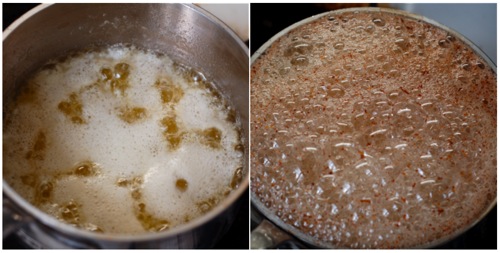
Taking Time in the Kitchen: Down to the Brown

Saturday, September 19th, 2009

brown_butter

Everyday cooking means taking lots of shortcuts. For the most flavor with the shortest amount of time in the kitchen, especially when you’ve splurged or gone out of your way to buy good ingredients, it’s a delicate balance between paying attention to the details and just trying to get dinner on the table.

We’ve all done it — cooked tomatoes with their peels and seeds, served pureed soup unstrained, fried the potatoes just once, not twice. It’s healthier, right?

(more…)


Rules of Thumb

Tuesday, August 4th, 2009

thumb_rice

There was a time, before Pyrex and Oxo, calculators and even cookbooks, when rules of thumb ruled the kitchen. My mother taught me my first one when I was six and still standing on a barstool to reach the kitchen faucet, the infamous and eerily accurate “one-knuckle” rule for cooking rice. Like all good R.O.T., the measures were flexible. It didn’t matter how much rice or what size pot or what kind of stove. It worked.

(more…)


Summer Trifle

Monday, July 20th, 2009

200907202029.jpg

The best summer desserts are simple to make, portable for picnics, and highlight the season’s sweet, luscious fruit. Trifle would be at the top of my own list.

While its name might lead you to think that this dish is of little consequence, it belongs in the pantheon of fantastic frugal food, along with panzanella (another wonderful summer dish) and pain perdue (good anytime of the year or day). Back when little bits of bread or cake were far too valuable to toss away, even if stale as a board, cooks invented ingenious ways to use up every last crumb. Dry cake has a way of soaking up endless flavor and, in the process, transforming itself into a silken gift.

(more…)


Fry Bread and Indian Tacos

Monday, June 22nd, 2009

200906221350.jpg

As California’s road trip season begins, it’s time to pull out that list of foods that are worth a detour or two. If you’re passing by or through tribal land, allow time in your day and space in your stomach for a stop at roadside stalls offering fry bread or, even better, Indian tacos. Many of us are all a-twitter about the mash-up of Korean bbq and tortillas. But this much quieter and long established blend of taco toppings on soft, still-hot flatbread is better than anything I’ve tasted from digitally hyped menus.

(more…)