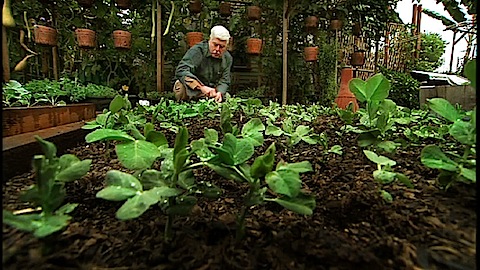
Just a mile from the skyscrapers of downtown Pasadena lies a tiny plot of land that has become the heart of an urban homesteading movement. The raised beds of the Dervaes family farm cover 1/10 of an acre. Imagine the area from a football field’s goal line to the very first 10-yard mark, or if you’re an average suburban homeowner, scan your backyard. Now, imagine harvesting 3 tons of organic food from this short span of soil every year.
Robert McFall’s documentary, Homegrown, is an intimate family portrait that reveals both the visionary inspiration and the resolute dedication required to grow one’s own food. For Jules and his adult children, Justin, Anais, and Jordanne, the Dervaes farm began as an experiment to see how much of their own food they could grow. A natural extension of the father’s experience during the back-to-the-land heyday of the 60s and 70s, their gardens soon led to living off-the-grid. They catch rainwater and recycle grey water, keep animals for manure and collect oil from nearby restaurants to produce their own biofuel. They order hand-cranked appliances from Amish catalogs. They put up their own green beans and illuminate their home with a self-reliant mix of olive oil lamps, biodiesel lamps, homemade candles, daylighting and the occasional fluorescent bulb.
Last month, Senate Majority Leader Dean Florez, an outspoken leader on food safety and animal rights, hosted a special screening of the documentary, FOOD, INC. for a roomful of legislators in Sacramento. Thanks to a friend who works at the capitol, I was able to sneak in. It’d been a very long time since I’ve been surrounded by that many people wearing suits, and discussing public policy is not one of my favorite ways to make small talk (SBX2 3 or SB 135, anyone?). But seeing this important film with a roomful of legislators who were excited about sustainable food and who could actually institute change was one of the most powerful experiences I’ve had in a movie theatre.
You will soon be hearing a lot about FOOD, INC., a documentary directed by Robert Kenner, winner of both a Peabody and an Emmy for his previous film, Two Days in October. Opening in San Francisco on June 12, this latest release by Magnolia Pictures tackles the unenviable job of educating consumers about the agricultural industry. It’s being called the Inconvenient Truth of the food world, and the quality of its production certainly compares well. Super-saturated colors, animation, engaging graphics, a sprinkling of humor to lighten its distillation of immense amounts of information, and a line-up of articulate, passionate speakers all meld into a highly viewable documentary.
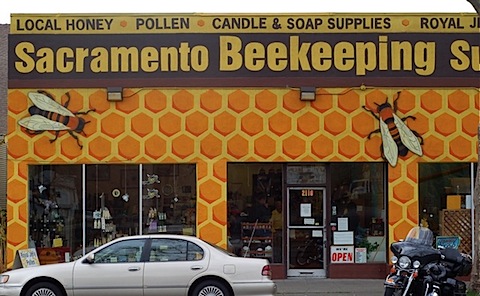
With spring just a few weeks away, it’s a busy day at the Sacramento Beekeeping Supplies. In between ringing up jars of local honey, three generations of the Stewart family answer a stream of questions with both patience and passion. If you’re curious about how bees make honey, which size wick to use in your candle-making, the science of animal communications or the health benefits of bee pollen, there’s no better place to spend an afternoon. If you’re already a dedicated beekeeper, well, then, you’ve probably already met Nancy and Fred, the proprietor and the talker, respectively, who run this gem of a shop.
Thousands have lived without love, not one without water.
– W. H. Auden
Like the earth itself, our bodies are 70 percent water. This also happens to be the proportion of our water supply that the agricultural industry consumes to bring food to our tables. No conversation about sustainable food systems can exclude the topic of water.
While water wars seem like the concerns of distant communities, experts predict that towns across the US will also soon be struggling to provide clean, affordable water to their citizens. An award-winning documentary, Flow, one of the post powerful and elegant films in the recent 3rd I Film Festival, tackles the complex issues embedded in a simple glass of water. From Bolivia to India, from Michigan to our very own California, access to water is being contested.
I’m not sure my neural pathways for good ice cream and the future of agriculture have ever sparked simultaneously before, but a recent posting sure caught my attention. If you happen to know someone who recently received their Ph.D. in entomology, you can point them, too, toward Haagen-Dazs’ recently established fellowship in honey bee biology at the University of California, Davis. For those who need more hands-on training, be sure to check out the advanced workshop later this month on queen bee insemination.
I have been up all night, my friends, in the quiet of my kitchen, sprinkling salt on shimmering slices of cucumber and watching the eggplant weep its bitterness. It is spring, and the winter stores are dwindling. read more…